
Record-Breaking Simulation Boosts Rocket Science and Supercomputing to New Limits
Spaceflight is becoming safer, more frequent, and more sustainable thanks to the largest computational fluid flow simulation ever ran on Earth.
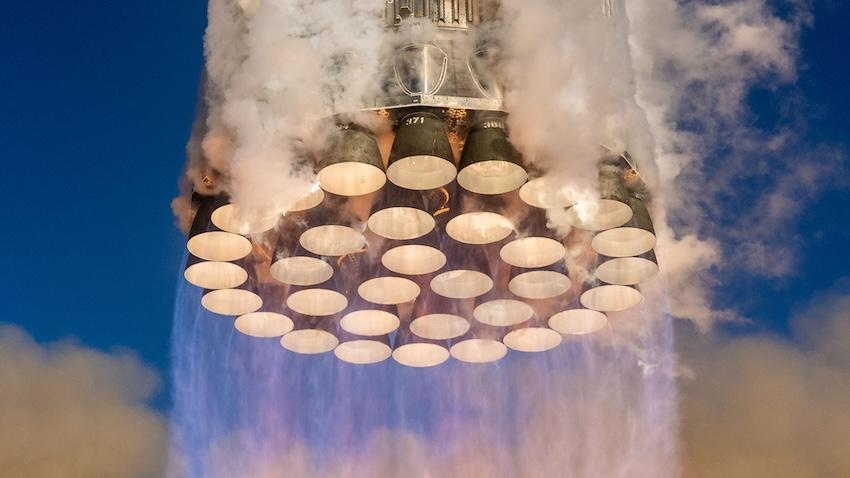
Inspired by SpaceX’s Super Heavy booster, a team led by Georgia Tech’s Spencer Bryngelson and New York University’s Florian Schäfer modeled the turbulent interactions of a 33-engine rocket. Their experiment set new records, running the largest ever fluid dynamics simulation by a factor of 20 and the fastest by over a factor of four.
The team ran its custom software on the world’s two fastest supercomputers, as well as the eighth fastest, to construct such a massive model.
Applications from the simulation reach beyond rocket science. The same computing methods can model fluid mechanics in aerospace, medicine, energy, and other fields. At the same time, the work advances understanding of the current limits and future potential of computing.
The team finished as runners-up for the 2025 Gordon Bell Prize for its impactful, multi-domain research. Referred to as the Nobel Prize of supercomputing, the award was presented at the world’s top conference for high-performance computing (HPC) research.
Inspired by SpaceX’s Super Heavy booster, a team led by Georgia Tech’s Spencer Bryngelson and New York University’s Florian Schäfer modeled the turbulent interactions of a 33-engine rocket. Their experiment set new records, running the largest ever fluid dynamics simulation by a factor of 20 and the fastest by over a factor of four.
The team ran its custom software on the world’s two fastest supercomputers, as well as the eighth fastest, to construct such a massive model.
Applications from the simulation reach beyond rocket science. The same computing methods can model fluid mechanics in aerospace, medicine, energy, and other fields. At the same time, the work advances understanding of the current limits and future potential of computing.
The team finished as runners-up for the 2025 Gordon Bell Prize for its impactful, multi-domain research. Referred to as the Nobel Prize of supercomputing, the award was presented at the world’s top conference for high-performance computing (HPC) research.
Recent Stories
Open Source, Big Ideas: Scientific…
Wednesday, August 26, 2026
New Model Teaches Workplace AI to Read More Like Humans
Wednesday, August 12, 2026
Georgia Tech Helps Advance…
Friday, July 24, 2026